

Actively managed patient pathways to co-ordinate efficient care
Elective single point of access (SPoA) is being introduced as part of a wider shift in planned care: away from fragmented referral routes and administrative transactions, and towards earlier, structured clinical dialogue between primary and secondary care.
NHS England guidance describes SPoA as a future-state approach for receiving, triaging and managing specialist advice and elective referrals through a single digital entry point, while recognising that local implementation will vary by specialty, workforce, digital maturity and regional need.
From October 2026, providers are expected to implement elective SPoA in priority specialties. The national direction of travel is clear: all specialist advice requests and elective referrals, excluding urgent suspected cancer pathways, should be directed through a single digital route at specialty or sub-specialty level. However, this does not mean every region will, or should, adopt an identical operating model.
As the guidance highlights, the current outpatient model “cannot meet the scale of demand safely, equitably, or sustainably”. Providers are struggling to meet existing referral to treatment targets – with only 61.5% of patients being seen within the 18-week window – and patients are frequently experiencing a frustrating version of care, being bounced around the system due to incorrect referrals and attending unnecessary appointments.
This approach aims to bring specialist review closer to the start of the pathway, create clearer communication between clinical teams, and help ensure that patients are directed to the right service, test or appointment first time.
Elective SPoA therefore offers an opportunity to transform how the most challenged and delayed parts of the patient pathway are coordinated, by creating a digitally managed process from referral through diagnostics to clinical decision-making.
What is elective SPoA?
At its simplest, elective SPoA is a single digital entry point for specialist advice and elective referrals into a specialty or sub-specialty. Rather than navigating multiple routes, referrers use one access point for the relevant clinical service. The request or referral is then reviewed by an appropriate specialist team, who determine the most suitable next step for the patient.
That next step could include advice to support continued management in primary care, a request for further information, a referral into a clinic, a straight-to-test diagnostic pathway, redirection to a more appropriate service, or another locally agreed outcome.
The important principle is that specialist clinical input happens early enough to shape the pathway, rather than only after a patient has waited for a first outpatient appointment.
A well-designed SPoA should make the system easier to navigate, not create another barrier or delay to patients receiving a diagnosis or treatment.
Digitally accelerated referral-to-decision pathways
One way to think about elective SPoA is as a distinct intermediary step between referral and definitive outpatient care. Through this lens, SPoA is not simply a mailbox or triage queue, but a clinical co-ordination layer that sits between services, where primary care, secondary care and diagnostic services can align and co-ordinate the referral-to-decision stage of the patient journey.
This matters because a significant amount of referral-to-treatment (RTT) time can be spent in the early part of the pathway: waiting for initial outpatient appointments, waiting for diagnostics, waiting for results, and waiting for clinical review.
If the front end of the pathway is better coordinated, patients can move more directly to the information, test or service they need.
A specialist team can review the referral context, request clarification if needed, advise on immediate management, coordinate diagnostics first where appropriate, and ensure the patient is directed to the right onward step. This can help prevent patients being passed between services, bouncing back to referral, reduce avoidable appointments and support safer, more consistent decision-making.
The traditional model and single point of access model diagrams
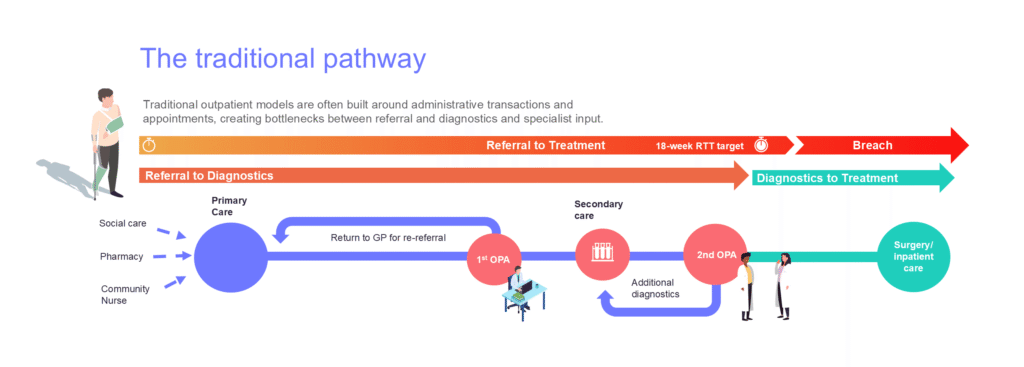
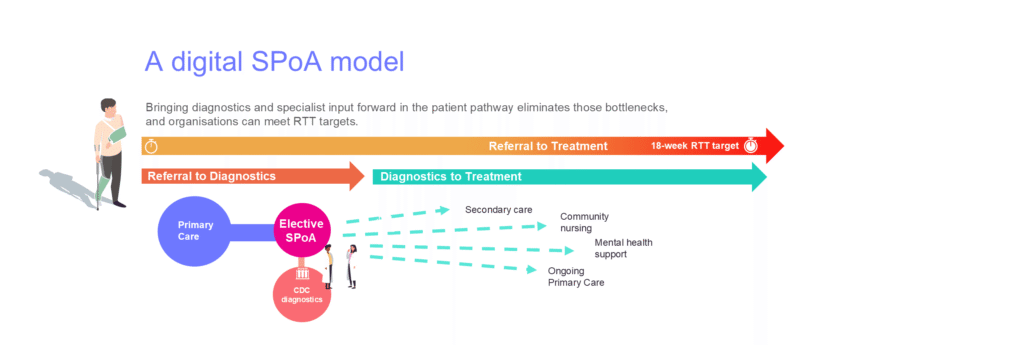
By creating SPoA as a distinct intermediary step between primary and secondary care in the traditional model, we can stop patients from being bounced around the system or ending up in bottlenecks by creating a more flexible, clinical discussion-led model.
Benefits of a diagnostics-first SPoA approach
- For patients: earlier specialist review, faster access to diagnostics and, where possible, bundled tests can provide clarity sooner and reduce unnecessary waits or avoidable hospital visits. Faster diagnosis supports patient confidence and helps them reach the right service before conditions deteriorate.
- For referrers: a transparent route to specialist input can support decision-making, clarify the next step and reduce uncertainty when a patient’s needs are complex.
- For specialist clinicians: better quality information at first review, improved use of specialist expertise and fewer unnecessary appointments, reducing strain and freeing up capacity.
- For operational teams: better visibility of demand and pathway status can make scheduling, capacity planning and escalation easier to manage.
- For systems and populations: supports RTT targets, waitlist recovery, and better uses diagnostic capacity whilst providing more consistent access routes and population health visibility.
How a digital patient management platform supports this
A digital patient management platform can facilitate this model of elective SPoA.
Bleepa supports providers by bringing incoming referrals, advice requests, diagnostic information, imaging, results and clinical discussion into a shared workspace. This allows teams to manage demand from a single dashboard while maintaining visibility of where each patient is in their pathway.
Rule-based tagging and breach alerts help teams identify urgent or at-risk cases, organise worklists by specialty or sub-specialty, and monitor progress against targets. Integration with e-RS means that SPoA activity supports national referral workflows rather than creating a separate, disconnected process.
Because clinical conversations can take place remotely and asynchronously, this approach can also help teams work across organisational boundaries. Specialists, referrers and diagnostic services can contribute to decisions without needing every discussion to happen in real time. This makes the model potentially adaptable for regional pathways, shared services and areas where workforce capacity needs to be used flexibly. This also creates a SPoA model that can operate at a place or system level, rather than an organisational one, which can then be configured to local and regional needs.
Conclusion
Elective SPoA is best understood and will be most effective in supporting elective reform as an opportunity to redesign the front end of planned care around earlier diagnostics and decision making, clinical collaboration, and pathway visibility and coordination.
A managed, digitally enabled access model that coordinates advice, referral review, diagnostics and onward care from a single point can help deliver this opportunity, creating a clearer, safer and more responsive way for patients to reach the right care first time.