

With our integration and interoperability capabilities and the unparalleled flexibility of our cloud architecture, we can provide healthcare organisations with a comprehensive digital health and diagnostics record, which can support neighbourhood health working or patient pathways across care settings. The record can supplement existing shared care records and electronic patient record systems by bringing together the relevant diagnostics and other data for clinicians to discuss with colleagues.
The record, and any clinical communication associated, is fully auditable and can write back to the patient’s medical record in order to meet the Care Quality Commission’s requirements to keep a ‘contemporaneous’ record (existing at the same time) to maintain clinical safety and reduce medico-legal risks.
Our patient-centric cloud architecture supports our solutions’ functionality, enabling controlled access for clinicians across care settings whilst simultaneously creating patient-specific records of care episodes.

Integrating with healthcare systems across care settings
We collaborate with a number of healthcare organisations to integrate with document management, patient management, referral and other IT systems in primary and secondary care. These systems include:
- Electronic patient records (EPRs): We have HL7 connections with Cerner Millenium, CLINiCOM, Lorenzo.
- Radiology information system (RIS): We receive orders from Wellbeing Software CRIS which can add a patient onto a pathway or generate an individual test. We can receive reports, attach them to the relevant patient in Bleepa and can also forward this report to the GP.
- Order comms: We integrate with Clinisys ICE order comms to receive orders and results.
- Laboratory information management systems (LIMS): We receive reports from Clinisys WinPath, attach them to the relevant patient and can then forward to the GP.
- Picture archiving communication systems (PACS): We have connections to Insignia, GE, Sectra, and Phillips PACS for sending, receiving, and querying DICOM images.
We also integrate with national NHS England systems – e-Referral service (e-RS), patient demographic service (PDS) and GP Connect. We are able to interoperate with any additional healthcare IT systems depending on customer needs.
Integrating with national NHS England systems
Our integrations with NHS England’s e‑RS, PDS and GP Connect enable seamless, scalable and patient‑centred clinical pathways across care settings.
- e‑RS – clinicians benefit from streamlined digital referrals and reduced manual workflow steps, improving productivity and user experience.
- PDS – ensures accurate patient identification and up‑to‑date demographic information, reducing duplication, misidentification and communication errors across organisations.
- GP Connect- enables clinicians in secondary care to securely share documents back to GP systems to support safer, faster and more coordinated care.
Together, these national‑level integrations support interoperable, secure data exchange, accelerate pathway deployment and enhance clinical decision‑making for both providers and patients across the NHS.

Patient engagement solutions
By integrating Bleepa with leading personal health record and patient engagement solutions such as Patients Know Best ensures that clinicians can manage referrals, review documentation, and access patient-submitted information within a single workflow in Bleepa, while patients receive clear communication, questionnaires, and pathway updates through their platform, including via the NHS App.
By combining Bleepa’s secure clinical collaboration tools with trusted patient-facing services, organisations can reduce duplication, streamline communication, and empower patients to take an active role in their care.
Integration engine
We use the industry standard Mirth healthcare integration engine, supplemented with our own custom libraries, to manage incoming and outgoing messages. This supports HL7, FHIR, direct SQL connection and web services.
Typical scenarios include:
-
Use of ADT (Admission, Discharge, Transfer) messages to update the location and status of patients.
-
Use of OMG (Generic Clinical Order)/ ORM (Order Entry message)/ ORU (Observation Results Unsolicited) messages to track the status of examinations and results from radiology, labs, etc.
-
Use of SIU (Scheduling Information Unsolicited) to track out patient appointments.
-
Use of MDM (Medical Document Management) to export transcripts of conversations on discharge.

Document management
Documents can be uploaded to Bleepa via HL7, file drops or image capture and can be sent from Bleepa to destinations such as document management systems, EPR or primary care via HL7, GP Connect / MESH or integration with trust document transfer systems.
PACS systems
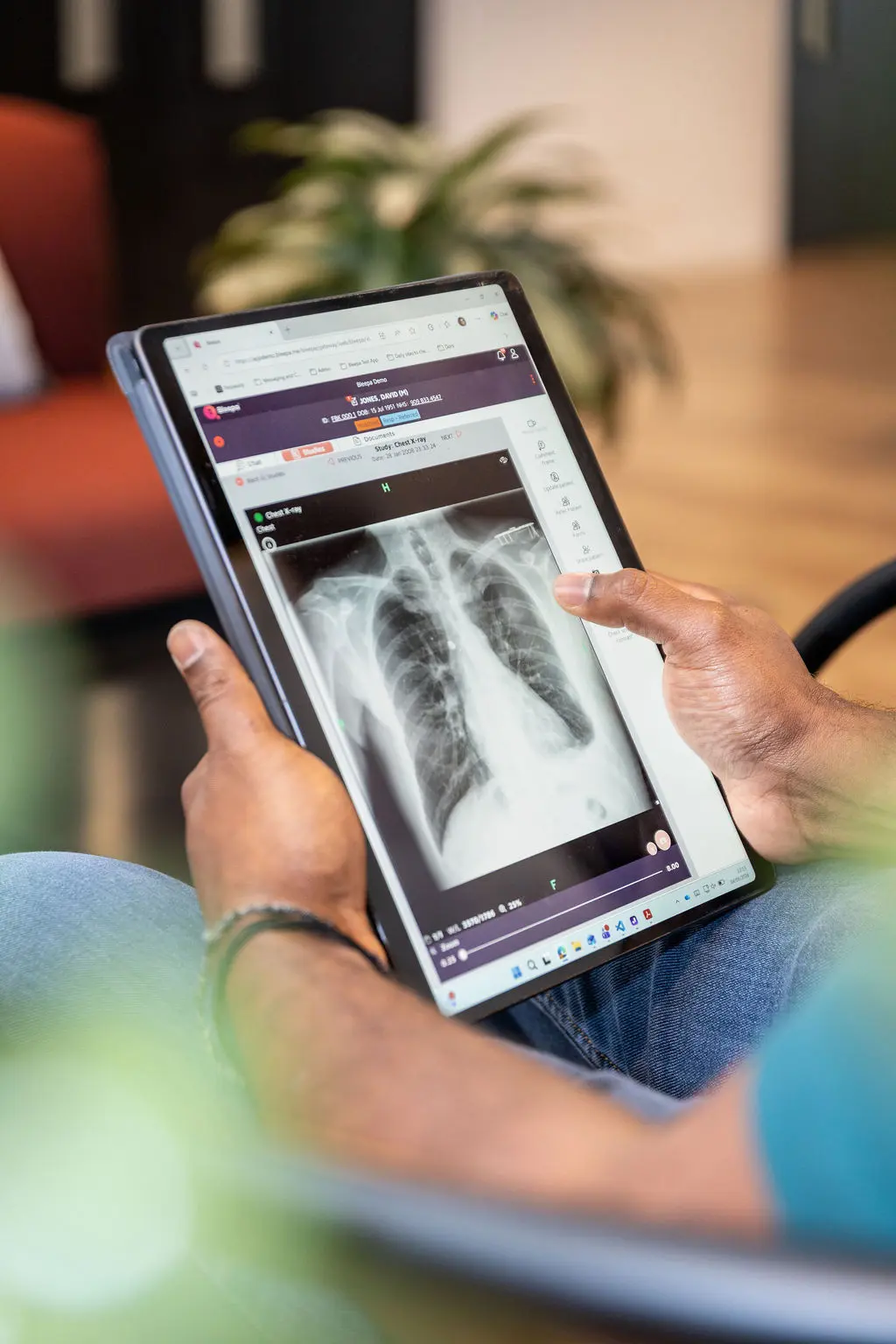
We have connections to various picture archiving communication systems (PACS) for sending, receiving, and querying DICOM images.
DICOM services include DICOM Store SCP and SCP, CFind SCU / SCP and CMove SCU / SCP.
Download our technical factsheet
Bleepa® is built for a streamlined approach, security, and scalability, helping improve workflows and patient outcomes.
Read more about our integrations, accreditations, deployment and technical capabilities in our technical factsheet.
Our accreditations