
How can digital pathways improve frontline productivity?
Streamline patient pathways with Bleepa’s end-to-end elective care solution that provides a digital alternative to traditional outpatient services, with upfront diagnostic tests and remote access to NHS specialists. This results in faster care with a 63% reduction in wait times against the 18-week referral to treatment target, 90% reduction in unnecessary appointments and 30% increase in productivity, reducing dependency on outsourced clinical resources.
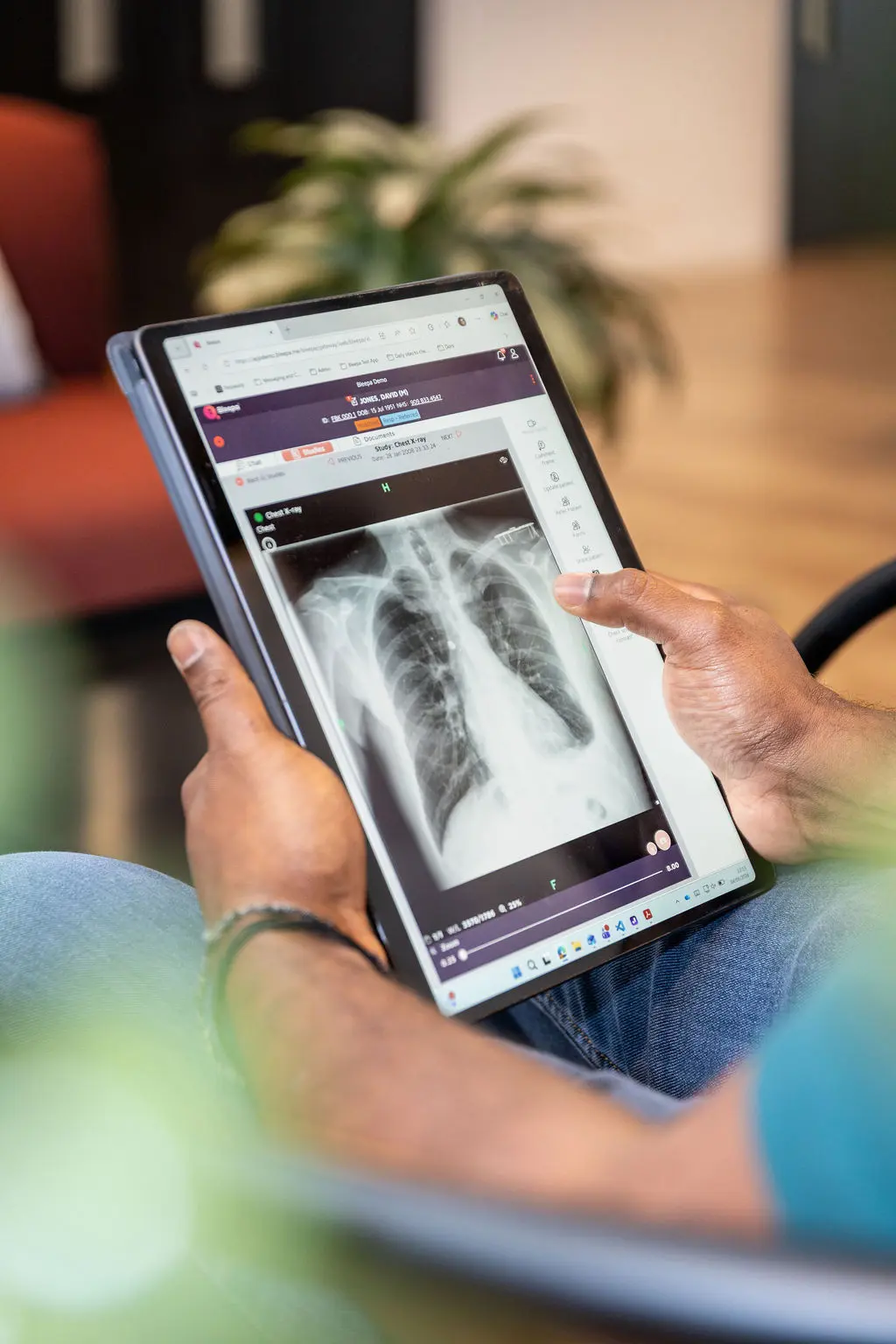
Bleepa connects clinicians across care settings and enables them to review patients asynchronously individually or as a multi-disciplinary team. It supports clinical teams to redesign services from analogue to efficient digital pathways, bringing the diagnostic information together with clinical communication for an enhanced view of the patient record.
Tests can be carried out sooner, if needed, to enable better and faster clinical decisions to be made on the basis of diagnostic evidence. The model optimises the use of clinical time and removes unnecessary outpatient appointments, improves productivity and significantly reduces wait times enabling healthcare organisations to hit their 18-week referral to treatment targets and reduce their waitlists.

Deliver sustainable digital change
Based on our award-winning programme at Queen Victoria Hospital NHS Foundation Trust, we’ve successfully demonstrated how an asynchronous, straight-to-test pathway approach can have an impact on removing unnecessary appointments and reducing wait lists using enhanced advice and guidance with diagnostic tests upfront.
This redesigned outpatient model:
- Transforms a 20-30 minute traditional outpatient appointment into a 5-10 minute asynchronous review
- Achieves up to a 90% reduction in outpatient appointments
- Achieves up to a 63% reduction in referral to treatment wait times compared to the national target (from 18 to 6.6 weeks)
- Delivers up to 30% more outpatient throughput than the traditional model, far in excess of the current 2% productivity target for the NHS
Bleepa can be used to facilitate any pathway, flexible to the clinical and operational needs of each specialty and care setting. It is an evidence-based, adoption-ready solution for healthcare organisations.
The collaboration enables a fully connected digital pathway – linking clinicians, diagnostic teams and patients – to deliver faster, safer and more personalised care.
“The vision from the beginning was to redesign the model of care so that once referred, patients went straight to diagnostics, thereby reducing the need for a first outpatient appointment and reducing the risks of bouncing patients back to GPs for further referrals to different specialties.
“With Bleepa as the technology enabler, this has optimised and automated multiple steps on the pathway with greater visibility of where the patient is on their care journey to multiple people across the clinical teams.”
Faster decision making
The new pathways optimise the use of existing resources, so that less time is taken on unnecessary activities and appointments – freeing up more time to be directed to where it is needed most and enabling faster decision making. Redesigning the model using Bleepa is supporting sustainable digital change across a region and replacing traditional, analogue ways of working with asynchronous healthcare.
The model has been in place at Queen Victoria Hospital NHS Foundation Trust in Sussex, winning an HSJ Partnership Award for Most Effective Contribution to Clinical Redesign and has also been outlined in the all-party parliamentary group for diagnostics report on community diagnostic centres – where Bleepa delivered a 90 per cent reduction in outpatient appointments and a 45 per cent reduction in referral to diagnosis times for a breathlessness symptom-based pathway.
Referral pathways before and after Bleepa

“As part of the QVH Breathlessness Pathway steering group, we provided the GP’s perspective to the team from the beginning. Our feedback was key to shaping the end-to-end process which is now streamlined, straightforward and well executed.
The pathway coordinator schedules the tests for patients on one day, meaning less trips to hospital and less time to reach a diagnosis. We receive a clear and concise summary of the outcome at the end of the patient episode, informing decisions for ongoing care. The pathway process is more efficient without any additional workload.”

Integrating with national NHS systems
Our integrations with national systems such as NHS England’s e‑Referral Service (e‑RS), personal demographics service (PDS) and GP Connect support interoperable, secure data exchange, accelerate pathway deployment and enhance clinical decision‑making for both providers and patients across the NHS.
- e‑RS integration – clinicians benefit from streamlined digital referrals and reduced manual workflow steps, improving productivity and user experience.
- PDS – Synchronisation with ensures accurate patient identification and up‑to‑date demographic information, reducing duplication, misidentification and communication errors across organisations.
- GP Connect – enables clinicians in secondary care to securely share documents back to GP systems to support safer, faster and more coordinated care.
Bleepa also integrates with a number of other document management, patient engagement, patient management and referral systems in primary and secondary care. We can interoperate with additional healthcare IT systems depending on customer needs.
Facilitate patient pathways
Patient pathways can be configured to speed up the referrals process:
- Straight to diagnostic tests
- Referral back to the general practitioner, where appropriate, reducing outpatient appointments
- Referral to multi-disciplinary teams in secondary care for treatment discussions
- Referral onward to specialist care for treatment, where needed
Bleepa supports assessment of patient needs and is fully auditable, making it easy to quickly show that safe, effective care has been provided. It also ensures that the care team has all the information they need for a holistic view of the patient’s needs, supporting the creation of timely treatment plans and capturing ongoing care requirements.
“The redesigned pathway has really helped to improve communication and collaboration between clinicians. Bleepa® has enabled us to review the results rapidly and have multi-disciplinary discussions virtually to expedite decision making. It is easy to refer patients onto the pathway and to discuss and respond to the GPs with our recommendations.”