
Frequently asked questions
About Feedback Medical
What is Feedback Medical and what services do you provide?
Feedback Medical delivers secure clinical communication, imaging and pathway solutions that help healthcare teams collaborate, review medical images, and make faster clinical decisions. Our award-winning platform Bleepa enables real‑time information sharing across care settings.
We help to streamline communication, reduce delays in clinical pathways, and give teams fast, secure access to medical images and patient information across disparate care settings – improving the speed and quality of care.
How does Feedback Medical support healthcare organisations and clinicians?
Bleepa connects clinicians across care settings and enables them to review patients asynchronously individually or as a multi-disciplinary panel. It supports clinical teams to redesign services from analogue to efficient digital pathways, bringing the diagnostic information together with clinical communication for an enhanced view of the patient record.
Tests can be carried out sooner, if needed, to enable better and faster clinical decisions to be made on the basis of diagnostic evidence. The model optimises the use of clinical time and removes unnecessary outpatient appointments, also significantly reducing referral to treatment times.
What makes Feedback Medical different from other digital health technology providers?
We specialise in secure, clinical collaboration tools designed around real NHS workflows. We work closely with healthcare organisations to develop solutions that meet their needs. Our solutions integrate easily with existing systems and support safe, asynchronous working and clinical decision-making.
Our experienced team with extensive backgrounds in the healthcare and technology sectors is dedicated to finding solutions that drive positive change in the healthcare industry.
Which hospitals, trusts or healthcare systems currently use Bleepa?
Feedback Medical is used by several NHS trusts and UK healthcare organisations to improve communication, speed up diagnostics, and support asynchronous care pathways.
Is Bleepa accredited or certified for clinical use?
Yes. Our solutions are developed to meet strict medical software, information governance, and data protection standards, ensuring safe use in regulated clinical environments. Bleepa is a secure, fully compliant UKCA-marked medical device certified for review of medical grade images and capture of clinical photographs.
Clinical and patient benefits
How does Bleepa improve patient safety and care quality?
By giving clinicians instant access to patient information, including medical imaging, and the ability to communicate more rapidly we reduce delays, support faster diagnosis, and help teams coordinate care more effectively – leading to patient outcomes.
By enabling communication, data access, and decision-making across teams and services, it empowers frontline teams to deliver integrated, real-time, population-focused care, and offers scalable technology to underpin the broader transformation across local populations.
How do your solutions help reduce diagnostic delays?
Our platform enables rapid image sharing, secure messaging and streamlined workflows so clinicians can collaborate asynchronously from anywhere, accelerating decision-making and reducing bottlenecks in patient pathways.
Tests can be carried out sooner, if needed, to enable better and faster clinical decisions to be made on the basis of diagnostic evidence. The model optimises the use of clinical time and removes unnecessary outpatient appointments, also significantly reducing referral to treatment times.
What are the benefits of using your platform for clinical teams?
Teams gain faster access to information, improved communication, and the ability to work across locations. This improves efficiency, reduces workload friction, and supports timely clinical decisions.
Bleepa’s push notifications alert clinicians whenever new patient information becomes available, ensuring timely action. Diagnostic results are presented directly to the care team, prompting collaborative decision-making to develop a management plan that is then shared across all care settings.
How can your technology help reduce clinical workload and burnout?
By simplifying communication and removing administrative and geographical barriers, our platform cuts unnecessary steps from clinical workflows, giving teams more time to focus on patient.
An independent evaluation of Bleepa showed that 80% of staff identified an improvement in staff communication when using it compared to previous referral methods.
Can Bleepa be used to support multidisciplinary team working?
Yes, Bleepa can support multidisciplinary working through its clinical-grade image sharing combined with its asynchronous communication which supports efficient, cost-effective team working across care settings.
Patients no longer need to wait for the next multi-disciplinary team slot for their treatment to be discussed and progressed along the care pathway. By dealing with more cases as soon as the diagnostic results are available – asynchronously – more time can be freed up to deal with the more complex cases in traditional face-to-face or virtual meetings.
Software and technology
What is Bleepa and how does it work?
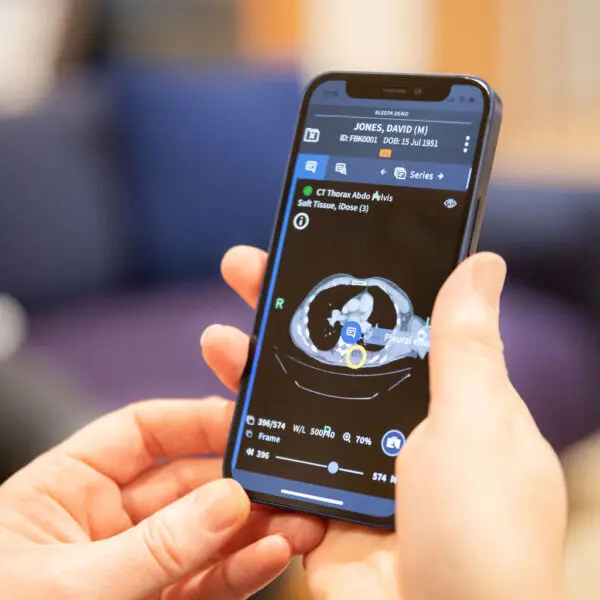
Bleepa is an easy-to-use collaboration platform for all patient referrals, diagnostic requests, clinical communication and patient pathways. It gives clinicians access to the clinical information (medical imaging, test results, case notes) they need to make decisions about patients in one place. It enables them to chat with colleagues, ask questions and seek advice and guidance about clinical care.
Bleepa is built as a series of modules that organisations can enable depending on their clinical or operational needs. It combines secure instant messaging with the ability to review complex medical imaging, case notes and test results. Bleepa’s functionality includes:
- patient list management
- structured referrals and pathway workflow
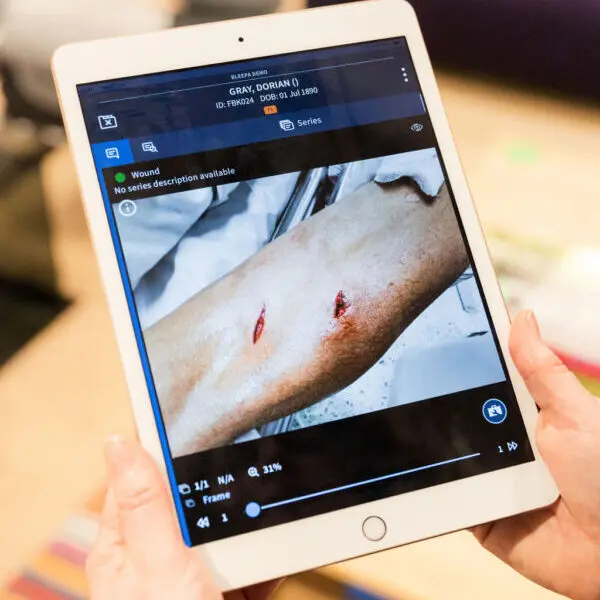
- radiology image review and clinical photo capture
- clinical communication and multi-disciplinary team collaboration
The modular design allows hospitals to tailor the platform to their care pathways. Read more information on our how Bleepa works page
What is a Bleepa asynchronous pathway?
A Bleepa asynchronous pathway is a digital clinical workflow that allows patient cases to move between teams without requiring everyone to be online or available at the same time.
The patient can be referred from primary care and triaged by an administrator or pathway coordinator, tests can be prioritised at the beginning of the pathway or other sites, and then secondary care clinicians can securely review images, add notes, request input, and update case information whenever they are available. Patients can then be referred back to primary care or on to further care depending on the case.
This reduces delays, supports faster decision‑making, and enables smooth collaboration across departments, sites and remote locations. By removing the need for real‑time coordination, asynchronous digital pathways help streamline clinical processes and ensure patients progress through their care pathway more efficiently.
Can Bleepa be used for asynchronous multi-disciplinary team working?
Yes, Bleepa can be used for multi-disciplinary team working whether that’s asynchronously or via face to face or virtual, scheduled meetings to review patient information and discuss cases. You can find out more on our MDT page here
Can Bleepa be used for advice and guidance?
Yes, Bleepa can and is used for advice and guidance between clinicians, whether they are general practitioners communicating with secondary care clinicians, or working within the same healthcare organisation. Bleepa can bring clinicians from anywhere into the conversation for specialist advice and escalate any issues to more senior members of staff.
Can you communicate with patients via Bleepa?
Bleepa was developed with communication between clinicians in mind but we integrate with patient engagement platforms such as Patients Know Best so that clinicians can view and share information as part of the pathways within Bleepa.
Is your collaboration platform secure and compliant with NHS standards?
Yes. Quality, information security, and clinical safety are all critically important to our customers to ensure compliance with NHS and other standards and safe sharing of sensitive patient information.
We align our working practices with compliance needs through a number of initiatives, including:
- Active maintenance of ISO 13485 certification – the Quality Management standard for Medical Device manufacture (certified since 2014).
- Active maintenance of ISO 27001 certification – the Information Security Management standard (certified since 2020).
- Fully documented and tested business continuity management processes and procedures audited as part of our ISO 27001 certification. ISO 27001 provides a focus on the Business Continuity requirements of IT systems, in direct alignment with the requirements outlined in the ISO 22301 BCM standard.
- Certification against the UK government Cyber Essentials and Cyber Essentials Plus standards
- Participating in the NHS’s Data Security and Protection Toolkit scheme
- Producing products that comply with the DCB0129 Clinical Safety Standard
- Aligned with the NHS Digital Technology Assessment Criteria (DTAC)
Bleepa is manufactured, deployed and supported by Feedback Medical under our validated quality and security processes, and the product holds a UKCA certification as a medical device for clinical communications and medical image display.
Can your tools be used across multiple devices (desktop, tablet, mobile)?
Absolutely. Clinicians can use the platform securely from desktops, tablets and mobile devices, supporting flexible and remote decision-making.
Some of Bleepa’s features are optimised for certain device types – for example, reviewing medical imaging is recommended on a desktop device, and using the photo capture feature is recommended on mobile or tablet devices.
Does Bleepa support a ‘bring your own device’ (BYOD) policy?
Bleepa can help healthcare organisations to adopt a BYOD policy for accessing clinical data on personal devices. Features such as being a zero footprint application, with data encrypted in transit and at rest, support BYOD use with the appropriate security measures in place.
Does Bleepa capture patient consent for photo use?
In line with information governance and data protection standards, Bleepa includes the capture of patient or guardian consent in the photo capture module.
What file types and imaging formats does your platform support?
We support standard DICOM medical imaging formats, along with a range of clinical document and media types used across healthcare systems.
What are the on-site network requirements?
Bleepa works over your existing network infrastructure, including wi-fi and mobile networks.
What is your system backup strategy?
All customer-facing systems and databases are backed up on a scheduled basis, so that we can rapidly restore the Bleepa environment with minimal data loss and maintain continuity of clinical care for our users.
Bleepa and national priorities
Is Bleepa aligned with national NHS digital transformation priorities?
Bleepa directly supports the NHS’s core digital transformation goals by providing a secure, clinically validated platform for medical image-based communication, asynchronous patient pathways and remote decision making. These capabilities underpin national aims to digitise pathways, reduce referral to treatment times, improve connectivity across care settings, and reduce unwarranted variation.
By enabling faster, clearer clinical collaboration, Bleepa helps organisations deliver the streamlined, data-driven processes set out in the NHS Long Term Plan, 10 Year Health Plan for England and the Reforming Elective Care for Patients Plan.
Does Bleepa help bring care closer to home, from hospital to community?
By removing unnecessary in-person appointments, Bleepa allows patients to receive timely and appropriate care while reducing the need to travel out of the community. The underpinning digital platform also has applications in the government’s plans for a neighbourhood health service.
In 2025, Bleepa was used as core technology for two neighbourhood healthcare simulations, in collaboration with NHS Providers and PPL, and with support from technology partner Optum.
Does Bleepa support the national push to better utilise community diagnostic centres and achieve diagnostic transformation through straight-to-test pathways?
Bleepa connects clinicians across care settings (primary, secondary and community diagnostic centres) and enables the diagnostic results to be immediately available to clinicians wherever they are. It supports clinical teams to redesign services from analogue to efficient digital asynchronous pathways, bringing the diagnostic information together with clinical communication for an enhanced view of the patient record.
Tests can be carried out sooner via the community diagnostic centre or other site, if needed, to enable better and faster clinical decisions to be made on the basis of diagnostic evidence.
How does Bleepa improve NHS clinical productivity and reduce elective waitlists?
The NHS’s primary clinical productivity target is to ensure that following a referral, 92% of people receive treatment within 18 weeks. In real-world applications, Bleepa’s digital standardised pathways reduced referral to treatment times by 63% compared to the national target (46 days compared to 126 days) for traditional pathways and 90% of patients did not need to be referred into secondary care outpatient services.
Data security, compliance and transparency
Is Feedback Medical GDPR compliant?
Yes. We follow strict GDPR, UK Data Protection and NHS information governance standards to protect patient data at every stage.
You can find out more about how we collect and use data in our privacy policy and our cookie policy
How do you ensure patient data remains secure and protected?
Data is securely encrypted in transit and at rest. Our systems undergo regular testing, monitoring and compliance reviews to maintain the highest security standards.
Where is patient data stored and processed?
Data is hosted in secure, compliant environments that meet NHS and GDPR requirements, ensuring full control and traceability.
Do you use cloud‑based or on‑premise deployment options?
We offer secure cloud deployment as standard, with flexible options depending on an organisation’s infrastructure and governance requirements.
Our patient-centric cloud architecture is secure, scalable and cost efficient. It supports Bleepa’s functionality whilst simultaneously creating patient-specific records of care episodes. It enables unparalleled flexibility and security, storing data at an individual patient level. This means you can manage the cloud roll-out process patient-by-patient, without the stress of mass data migration.
What cybersecurity measures are built into your systems?
We use encryption, multi factor authentication, secure audit trails, and continuous monitoring to protect sensitive clinical data. Bleepa is a zero footprint application which means that no patient-identifiable data is stored locally on any user device.
By default patient records are purged in Bleepa after a period of time.
Bleepa is developed in compliance with UK GDPR, ISO 27001 and Cyber Essentials Plus.
Implementation and training
How long does it take to implement your system in a hospital or clinic?
Implementation is fast and minimally disruptive, with deployments often completed in weeks depending on the complexity of system integration and configuration to customer needs.
Longer timeframes may be needed for multiple pathway, multi-site deployments but we will fully assess customer needs before a project commences. Each implementation has a dedicated project manager ensuring an effective deployment and the co-development of a project plan with agreed milestones and delivery targets.
Detailed clinical, functional, and technical requirements are documented as part of the plan. An assessment of risk is required and carried out for all projects, and mitigation strategies that need to be implemented to reduce the risk are mapped with the customer.
What training do clinical teams receive when adopting your platform?
We provide tailored training sessions, onboarding support, and quick start guides to ensure teams feel confident from day one. Bleepa is very intuitive and easy to use with minimal need for training and support.
Do you offer support during and after deployment?
Yes. Our support team offers ongoing technical assistance, platform monitoring and user guidance to ensure long‑term success. We work closely with our customers to support them during and after deployment to understand shifting priorities and additional requirements.
Ongoing support can be accessed through our customer support channels including the Bleepa help desk . This includes access to:
- A dedicated Bleepa support email.
- Telephone support.
Where further or enhanced support levels are required (including web chat or onsite support), we would be happy to discuss additional charges depending on the specific requirements.
What technical requirements are needed to run Feedback Medical solutions?
Our platform works with standard clinical IT infrastructure and integrates easily with existing national NHS and other healthcare systems, requiring minimal additional setup and support from internal customer IT departments.
Can your platform be tailored to different clinical workflows?
Yes. We work with healthcare organisations to configure workflows that support their clinical pathways and operational needs.
Pricing and licensing
How much does Bleepa cost?
Pricing varies depending on deployment size, features and integration needs. We offer flexible, scalable packages for organisations of all sizes. Please contact our sales team at sales@fbkmed.com for more information
Do you offer subscription models or enterprise licensing?
Bleepa is licensed on a modular basis. We provide subscription-based pricing and enterprise licensing options depending on the modules relevant to customer needs and to support both single‑site and multi‑site organisations. You can find out more about the modules and features on the how Bleepa works page.
Are there cost savings for multi‑site or large healthcare organisations?
Yes. We offer scalable pricing and economies of scale for trusts and healthcare systems deploying across multiple sites.
What support is included in the licensing fee?
Licensing includes platform access, updates, user support, training and ongoing system maintenance. Our customer support is available during office hours as standard and outside office hours on request (additional fees may apply).
Do you offer pilot programmes or trials?
Yes. We offer supported pilot and trial options so organisations can evaluate the platform’s clinical and operational benefits before full deployment.
What purchasing frameworks is Bleepa available on?
Bleepa is available on the following technology and healthcare frameworks:
- Clinical Digital Health Solutions
- Digital Diagnostic Solutions
- Digital Outcomes & Specialists 6
- Health Innovation Framework
- The Provision Artificial Intelligence (A.I), Imaging and Radiotherapy Equipment, Associated Products and Diagnostic Imaging
Research, innovation and case studies
Do you have evidence or case studies demonstrating clinical impact?
Yes. Our case studies highlight reductions in clinical delays, improved team communication, and enhanced patient outcomes across NHS and international sites.
The benefits of Bleepa from improving productivity to sustainability are highlighted in our benefits section.
How does Feedback Medical support research and innovation?
We collaborate with healthcare organisations and research teams to develop new workflows and evaluate innovative clinical use cases.
How do you work with partners, trusts or academic organisations?
We collaborate closely with clinical teams, technical partners and academic groups to co‑design solutions that meet real-world healthcare needs. Our partners are highlighted on our homepage and further information is published in our news feed.
Getting started
How can my hospital or practice start using Bleepa?
Simply contact our team to arrange a consultation, demo or pilot. We’ll assess your needs and recommend the ideal implementation approach
Do you provide demos or walkthroughs of your platform?
Yes. We offer guided demos that show how our collaboration tools support faster, safer clinical care. Please contact sales@fbkmed.com to arrange a demo of Bleepa.
Who can I contact for more information or support?
You can reach our team via our website’s contact page. We’re happy to provide support, answer questions or arrange a demo.
How quickly can a team begin using the system after signing up?
Once integration and onboarding are complete, teams can begin using the platform immediately with full support from our implementation specialists.